Agriculture remains a major source of livelihood in Assam, supporting a substantial share of the state’s workforce and rural economy. Yet, access to assured irrigation continues to be a critical challenge. Government figures on irrigation expansion, when read alongside the state’s Economic Survey and audit findings, raise questions not only about infrastructure creation but also about its actual use and benefits to farmers.
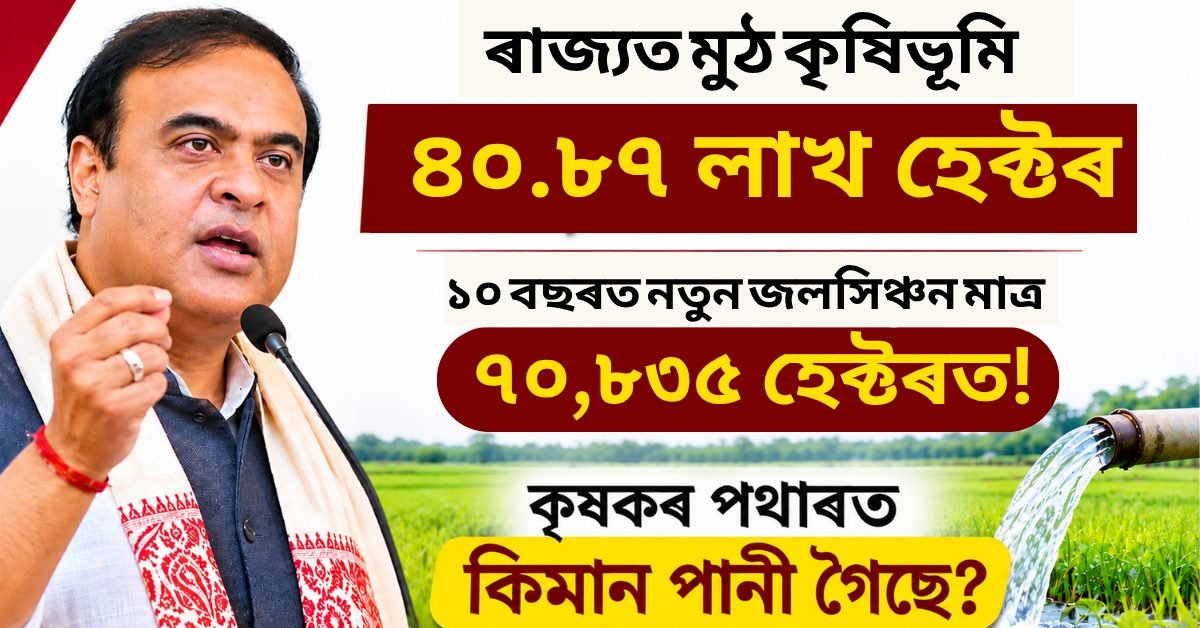
According to information presented in the Assam Legislative Assembly on July 22, 2026, only 70,835 hectares of agricultural land received new irrigation facilities between the financial years 2016-17 and 2025-26. Irrigation Minister Pijush Hazarika provided the figures in response to Starred Question No. 171 raised by MLA Akhil Gogoi. The government also stated that ₹7,070.92 crore had been allocated for various irrigation schemes during the period.
The figures invite a larger question: how much of the money allocated for irrigation has translated into reliable water supply, higher farm productivity and better incomes for cultivators?
Irrigation Potential Does Not Automatically Mean Irrigation Access
The creation of irrigation potential is only the first stage. The real test is whether farmers receive water when crops need it, whether schemes remain operational and whether the facilities enable farmers to cultivate more than once a year.
Assam’s Economic Survey 2025-26 provides an important perspective. It states that the Irrigation Department had created an irrigation potential of 8,84,751 hectares by the end of 2024-25. However, farmers utilised 2,50,291 hectares under government irrigation schemes during 2024-25.
These figures should not be confused with the 70,835 hectares of newly covered land cited in the Assembly reply. They measure different aspects of irrigation. The Economic Survey also clarifies that the Irrigation Department does not maintain utilisation data for private irrigation systems or schemes implemented by the Agriculture Department and other agencies. Therefore, the utilisation figure is not a complete measure of all irrigation activity in Assam.
Nevertheless, the gap between potential created and utilisation under government schemes raises questions about operational efficiency, maintenance, water distribution and farmers’ access.
The Economic Cost of Unreliable Irrigation
Assured irrigation can help farmers reduce dependence on seasonal rainfall, cultivate rabi crops, diversify production and increase cropping intensity. When irrigation is unreliable, farmers may hesitate to invest in a second crop, improved seeds, fertilisers or agricultural equipment.
The consequences extend beyond individual farms. Lower or uncertain agricultural production can affect demand for farm labour, seeds, fertilisers, machinery, transport, storage and local markets. It can also limit the growth of small businesses linked to agricultural processing and distribution.
An earlier performance audit by the Comptroller and Auditor General (CAG) on minor surface irrigation schemes in Assam found that paddy production increased by around 18 per cent for sali paddy and 37 per cent for boro paddy among the surveyed farmers after irrigation facilities were provided. Around 60 per cent of respondents reported an increase in income. However, the audit also noted that most surveyed farmers considered their agricultural income insufficient to sustain their livelihoods.
The findings underline that irrigation can improve production and income, but infrastructure alone cannot guarantee economic security. Farmers also need reliable water supply, access to markets, storage, fair prices and support for agricultural investment.
A Direct Link to Rural Employment
The irrigation question is also an employment question. A NITI Aayog report on sectoral employment trends states that agriculture accounted for 47.2 per cent of Assam’s workforce in 2023-24. This means nearly half of the state’s workers were engaged in agriculture.
When farmers can cultivate multiple crops, demand for labour can rise across sowing, transplantation, harvesting, sorting, packaging and transportation. Higher agricultural output can also support food processing, cold storage, rural trade and other allied activities.
Conversely, limited irrigation can restrict the number of crop cycles and reduce the availability of farm work during parts of the year. This may contribute to seasonal underemployment, unstable household incomes and migration in search of work.
However, irrigation deficiencies should not be presented as the sole cause of unemployment in Assam. Employment outcomes also depend on industrial growth, services, skills, investment and the availability of non-farm jobs. The connection is that a weak agricultural economy can make the employment challenge in rural areas more difficult.
Audit Findings Raise Questions Over Project Delivery
The CAG’s State Finances Audit Report for 2024-25 identified 11 incomplete projects under the Irrigation Department, with an estimated cost of ₹58.02 crore. The report listed these among 33 incomplete capital projects across departments.
An earlier CAG performance audit had also pointed to inadequate maintenance funding, inactive Water Users’ Associations and weaknesses in the management of irrigation schemes. These findings suggest that the challenge is not limited to constructing new infrastructure; ensuring that existing schemes remain functional is equally important.
The government must therefore explain how much of the allocated money was actually spent, how many projects were completed, how many remain operational and how many farmers receive water regularly.
The Assembly figures and audit observations make several questions relevant:
- How much of the ₹7,070.92 crore allocation was actually spent?
- Which districts and schemes account for the 70,835 hectares of newly covered land?
- Why did farmers utilise only 2,50,291 hectares under government irrigation schemes in 2024-25 against the 8,84,751 hectares of irrigation potential created?
- When will the 11 incomplete irrigation projects be completed?
- How much have crop yields and farm incomes increased because of irrigation?
- Has irrigation expansion resulted in more multiple-cropping land and additional rural employment?
Assam’s agricultural development cannot be measured only by the number of schemes announced or the amount of money allocated. The real indicators are the availability of water at the farm level, the area actually irrigated, the increase in crop production, the improvement in farmers’ incomes and the creation of sustainable rural livelihoods.
If thousands of crores are allocated but farmers continue to face uncertainty over water supply, the government must account for the gap between expenditure, infrastructure and outcomes. Irrigation is not merely an engineering project. It is a foundation for agricultural productivity, rural purchasing power and employment.