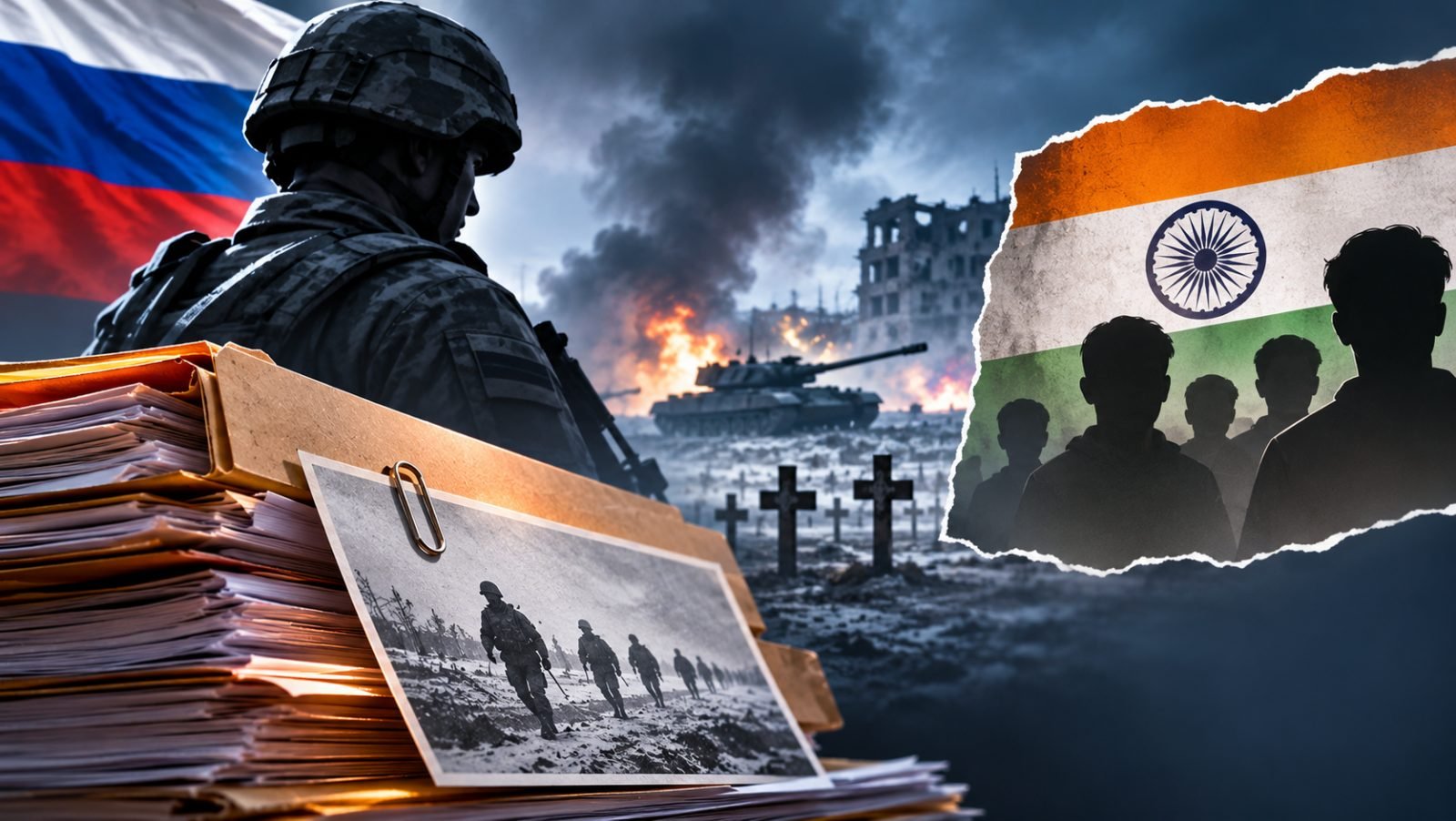
Alexander Korepanov signed up to fight for Russia in August 2023. He was wounded twice on the battlefield—and twice sent straight back to the front. On May 11, 2025, after 20 grinding months at war, the 52-year-old was killed in the village of Uspenovka, near the eastern Ukrainian city of Pokrovsk.
He did not die alone. More than 5,000 Russian men died alongside him in that single week. At the height of Moscow's spring offensive around Pokrovsk, the Russian army was losing a staggering 720 soldiers every 24 hours—the deadliest rate of the entire conflict.
For nearly five years, the Kremlin has guarded its true battlefield casualties as a tightly classified state secret. Now, an explosive data investigation by The Guardian has shattered that wall of silence. Working from a leaked cache of more than 11 million official death certificates held by Russia's Federal State Statistics Service (Rosstat)—obtained by the Belarusian opposition-linked hacking group Cyber Partisans and the Ukrainian hacker collective Silent Crow—journalists have pieced together the most unforgiving portrait yet of Russia's parallel wars in Europe and Africa.
The Hidden Toll in Ukraine—and a Silent Epidemic of Suicides
Across its multi-part series published on November 9 and November 23, The Guardian documented more than 400,000 Russians killed fighting in Ukraine. Researcher Janis Kluge, who analyzed the dataset, told the newspaper that monthly fatalities repeatedly surged past 15,000 in late 2024 and 2025: "That's 500 a day, above 500 a day. Certainly shocking."
Buried inside the same registry is an even darker truth the Russian military refuses to acknowledge: a steep rise in troops taking their own lives. In a companion report on Russian military suicides, The Guardian identified 1,087 suicides by military personnel—at least 614 of them in occupied areas of Ukraine or Russian border regions such as Belgorod and Bryansk, plus 108 men under the age of 25 who died by suicide elsewhere inside Russia away from the front. Recorded suicides climbed from over 50 in 2022 to 365 in 2025, with incomplete 2026 records already showing nearly 300.
"There's clearly a lot of coercion used by the Russian military to force people to go forward. In some cases, they will abuse them, torture them, use different types of physical abuse. So it's not surprising that some guys commit suicide."
— Rob Lee, Senior Fellow at the Foreign Policy Research Institute, quoted in The Guardian
Activists say even Russia's leaked files understate the despair. "I would say it is a low estimate," Ivan Chuvilyaev, spokesperson for the desertion-aid group Idite Lesom, told The Guardian. "Obviously, it is a lot more."
Blood in the Sahel: 349 Russian Fighters Killed in Mali
The leaked Rosstat death certificates do not stop at Ukraine's trenches. In a third explosive disclosure published on November 24, The Guardian uncovered 349 Russian fatalities in Mali between September 2023 and September 2026, where Wagner mercenaries and their state-run successor, the Africa Corps, have propped up Mali's military junta in exchange for security contracts and access to resources.
- The Deadliest Day in Africa: Records pinpoint 70 Russians killed on July 27, 2024 during the devastating ambush at Tinzaouaten near the Algerian border—almost all in Mali's Kidal region—the heaviest single-day loss for Russian fighters in Africa since Wagner first deployed to the continent in 2017.
- A Humiliating Retreat From Kidal: The leaked files also expose 43 Russian deaths on April 25 across Kidal, Aguelhok, Bamako, and Gao—where rebels shot down a Russian military helicopter that day. By the following morning, Russian forces had abandoned Kidal, a strategic northern town Moscow had touted since late 2023 as the showcase of its growing African footprint.
- A Shadow War Across Continents: Citing two knowledgeable sources, The Guardian further reported that Ukraine has quietly extended its conflict into West Africa by assisting Tuareg rebels battling Russian troops in the Sahel.
The India Angle: 51 Dead, 77 Untraced—and a Supreme Court Ultimatum
For dozens of households across Rajasthan, Punjab, Haryana, and Himachal Pradesh, Moscow's culture of military secrecy is not a distant geopolitical story—it is a daily agony. Just weeks before the Rosstat leak surfaced, India's Ministry of External Affairs (MEA) placed sobering figures before the Supreme Court of India.
As reported by The New Indian Express and PTI, the MEA informed a bench of Chief Justice Surya Kant and Justice Joymalya Bagchi in October that 51 Indian nationals who ended up fighting in the Russia-Ukraine war have died, while 77 Indian recruits remain completely untraced. Observing that many bereaved families have yet to receive promised payouts—and seeking exact figures on compensation paid by Moscow to six documented families—the top court asked the MEA to issue a public notice inviting affected kin to come forward for repatriation, legal aid, and compensation, as also detailed by The Tribune.
With Russia's own leaked death registries confirming the scale of frontline attrition and institutional obfuscation, Indian families and legal petitioners face an urgent question: how many of the 77 missing men are buried inside classified Russian records that Moscow has never shared with New Delhi?
Official Position
The Kremlin classifies official military casualty and suicide figures as state secrets and has not publicly verified the leaked Rosstat database. Following the July 2024 Tinzaouaten ambush in Mali, Wagner issued a rare public statement acknowledging fatalities—including a senior commander—without ever disclosing a final death toll.
Source Credits & Verification: Original investigative reporting by The Guardian (Ukraine Toll & Pokrovsk), The Guardian (Military Suicides), The Guardian (Leaked Data Analysis), and The Guardian (Mali Casualties); Indian court proceedings via The New Indian Express, PTI, and The Tribune.