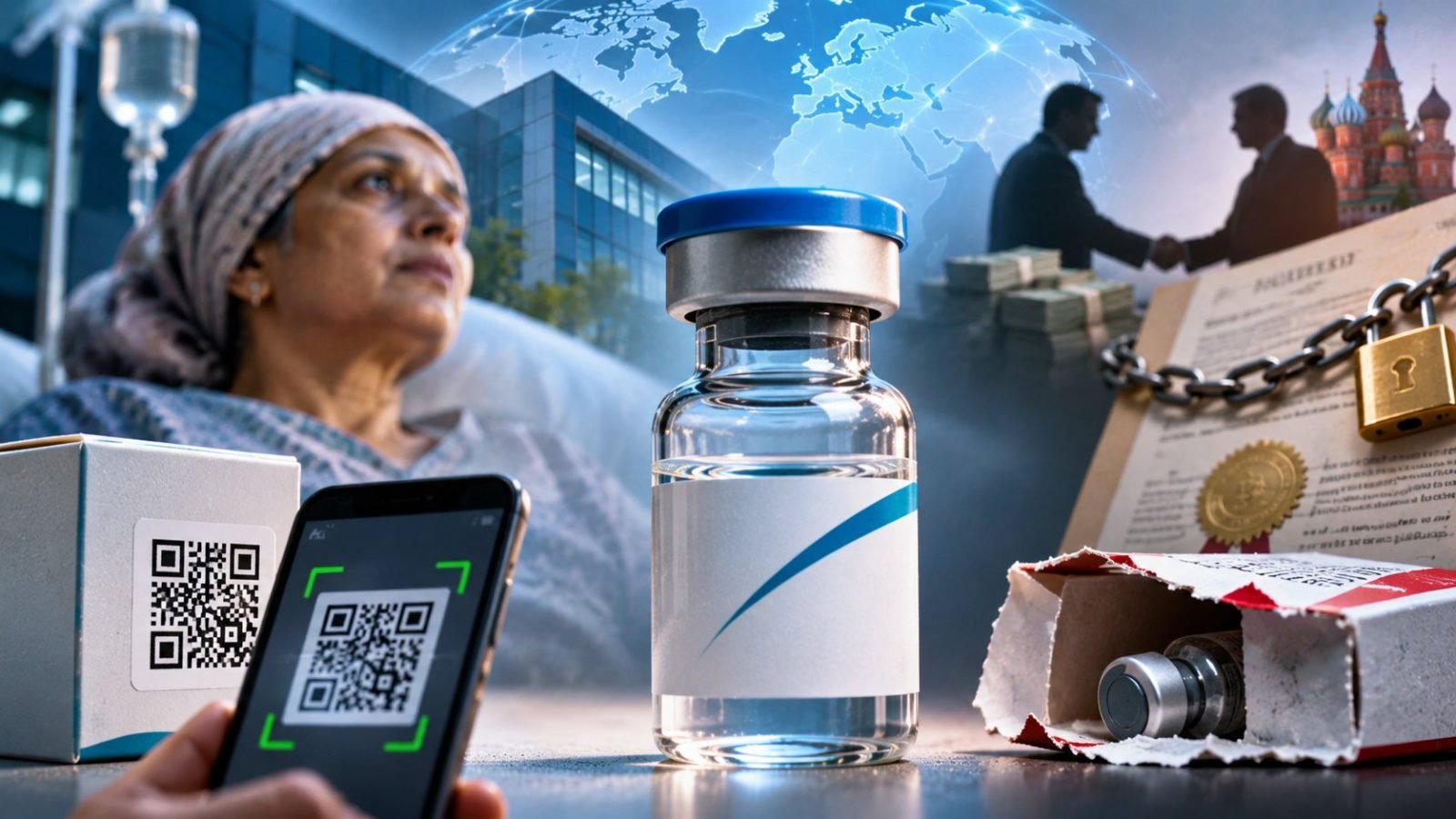
Walk outside the emergency ward of AIIMS in New Delhi and you will meet families selling ancestral land to afford a single vial of immunotherapy. For millions of cancer patients worldwide, the name on that prescription is Keytruda—a breakthrough treatment approved for 19 tumor types that has turned into the most lucrative medicine on earth.
In 2025 alone, Keytruda brought pharmaceutical giant Merck & Co. $31.7 billion—nearly half of the company's total revenue—pushing its cumulative haul since 2014 to almost $163 billion. Yet behind those staggering profits lies a global access crisis documented by 124 journalists across 48 newsrooms in the International Consortium of Investigative Journalists' ongoing series, Cancer Calculus.
The Patent Fortress—and Alleged Kickbacks in Russia
Armed with 1,018 public-record requests filed across 27 countries, ICIJ and its partners uncovered how Merck erected a wall of 50 active U.S. patents in 2026—a stream of follow-on filings that could block cheaper generic and biosimilar competition for up to 14 years after the drug's original patents expire in 2028. While Merck funneled nearly $75 billion into shareholder dividends and $43 billion into share buybacks, its pricing left health systems straining and patients fighting years-long legal battles just to stay alive. Even clinical dosing came under fire: World Health Organization estimates cited in the investigation show that shifting lung cancer patients to weight-based dosing could save $5 billion globally by 2040.
This November, the investigation widened sharply:
- Whistleblower Claims in Russia: In a November 2 report, ICIJ cited confidential whistleblower disclosures alleging that Western pharma giants paid massive bonuses to Russian middlemen—including distributors previously tangled in anticompetitive pricing cases—to win public oncology contracts, inflating treatment costs for patients. Whistleblowers described the companies' conduct as "the very definition of being willfully blind."
- U.S. Reform Stalling: A November 13 ICIJ dispatch warned that following the post-midterm shift in the U.S. Congress, time is rapidly running out on bipartisan bills designed to curb pharmaceutical patent thickets.
The India Angle: ₹1.5 Lakh Vials, Counterfeit Traps, and a 9-Point QR Shield
Nowhere are the human consequences of global drug-pricing walls starker than in India. As joint reporting by ICIJ and The Indian Express revealed, a single 100-mg vial of Keytruda carries a market price of ₹1,50,000 (over $1,500) in India—putting genuine treatment far beyond the reach of most households.
That price chasm created a hunting ground for counterfeiters who sold fake Keytruda vials to desperate families—and even to cross-border patients, including at least one Nepalese woman who bought medicine from an accused seller in India. Following the exposé, Indian authorities moved to tighten the supply chain, requiring manufacturers to print QR codes containing nine mandatory datapoints—including a unique unit ID, manufacturing and expiry dates, and manufacturer address—on cancer drugs, vaccines, antimicrobials, and narcotics.
"Sometimes counterfeiters may use the same packaging to beat the system. But even then, it would only work if the fake product is purchased and logged into the system before the genuine product."
— Supply-chain expert quoted in ICIJ & The Indian Express
Still, regulators face a sobering reality check: for Indian patients, genuine safety will remain elusive as long as lifesaving cancer care remains priced like a luxury asset.
Official Response
Merck has rejected criticism of its patent portfolio, telling ICIJ that patent counts do not predict when generic competitors enter the market. On the November Russian distribution disclosures, R-Pharm's spokesperson stated that Russia's procurement system is transparent and "based on open competitive bidding procedures," while Novartis said it had "conducted a thorough investigation into the specific activities."
Source Credits & Verification: Original reporting by ICIJ (Cancer Calculus Hub), ICIJ (Keytruda Pricing & Patents), ICIJ & The Indian Express (India Counterfeit Scandal & QR Rules), and ICIJ (Russian Distributor Whistleblowers).