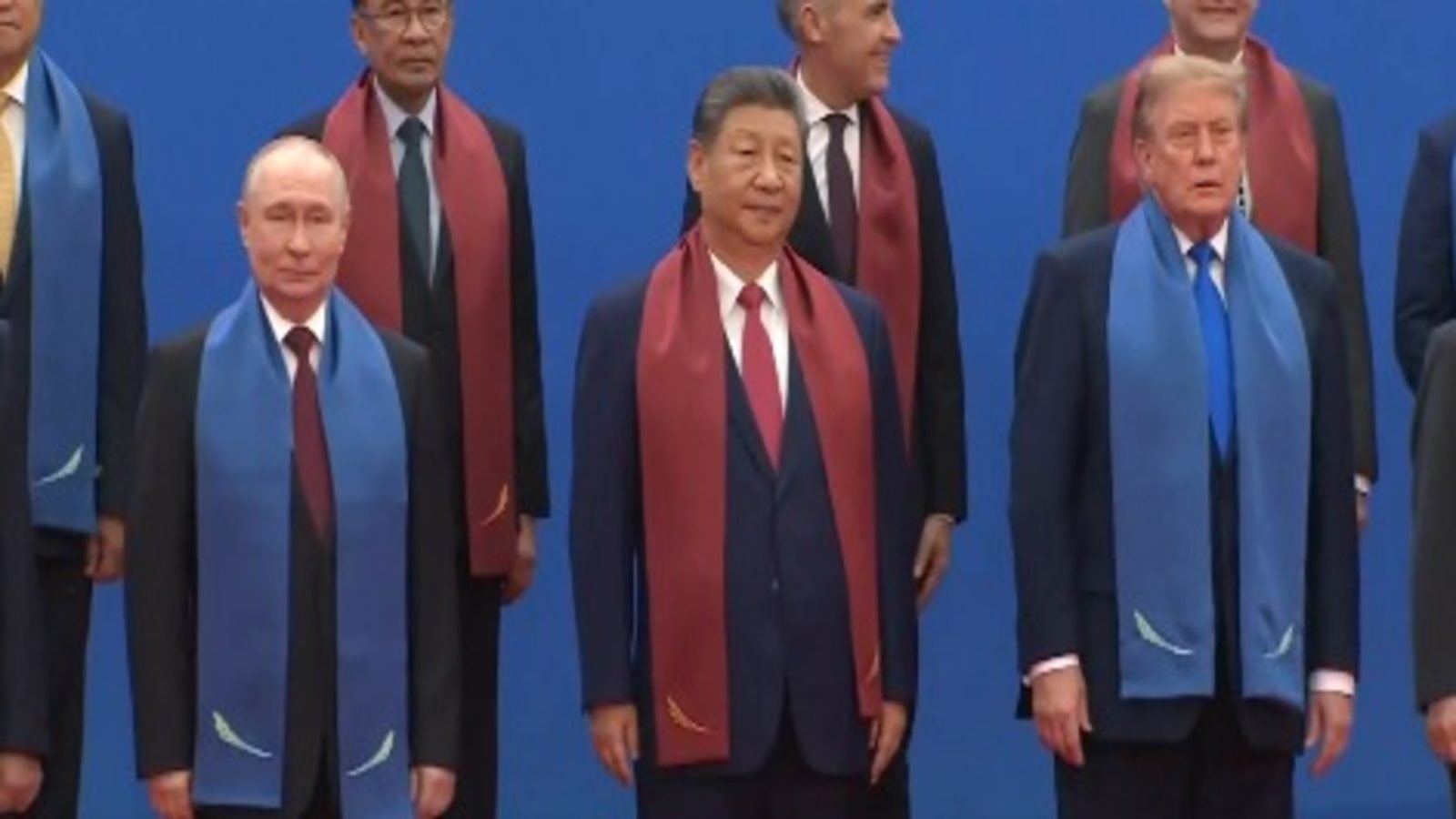
The leaders of three of the world’s most powerful military nations—the United States, China and Russia—are set to hold their first-ever trilateral meeting in Shenzhen, China, on Thursday. US President Donald Trump, Chinese President Xi Jinping and Russian President Vladimir Putin are expected to meet on the sidelines of the Asia-Pacific Economic Cooperation (APEC) summit.
The discussions are expected to cover the US-Israeli war on Iran, Russia’s war against Ukraine, nuclear weapons, international trade and artificial intelligence. However, analysts say the three leaders have very different priorities and that few concrete outcomes should be expected.
Trump seeks diplomatic gains and a nuclear agreement
For Donald Trump, the meeting offers an opportunity to secure a diplomatic achievement that he can present as a political success at home. Analysts say his position has come under pressure following the Republican Party’s defeat in the US midterm elections, which resulted in Democrats gaining control of both chambers of Congress.
The war involving Iran has also complicated Trump’s political position. During his 2024 presidential campaign, he had pledged not to drag the United States into another prolonged war. The current deadlock with Iran has been described by observers as a “frozen war”.
Washington hopes Beijing will privately urge Tehran to make compromises. Trump may also raise the possibility of a new trilateral nuclear agreement involving the United States, Russia and China.
The New Strategic Arms Reduction Treaty (New START), which limited the strategic nuclear arsenals of the United States and Russia, expired in February 2026. Trump has called for a new, modernised agreement that includes China. Beijing, however, is understood to be reluctant to join a treaty it had no role in drafting.
Putin wants to address Ukraine and Russia’s isolation
For Russian President Vladimir Putin, the Ukraine war and the diplomatic isolation caused by Western sanctions are central concerns. Moscow wants to maintain its relationship with the Trump administration, gain more Ukrainian territory and reduce Washington’s support for Kyiv.
Russia’s minimum demands include full control of the Donbas region and Ukraine abandoning its ambition to join NATO. However, Ukraine is not expected to be part of the formal agenda, as Xi is reluctant to become directly involved in what Beijing considers a European issue.
Analysts also say Putin is unlikely to make any binding commitment to Washington that Russia will stop cooperating with Iran. The Kremlin is keen to prevent further sanctions and wants to challenge the perception that Russia has become internationally isolated.
Xi wants room to pursue China’s long-term interests
As host, Xi Jinping is seeking greater freedom to pursue China’s political, economic and military objectives without external interference. Beijing wants to avoid another trade war with Washington, secure recognition of its influence in rare-earth minerals and technology, and prevent US opposition to its position on Taiwan.
The US-China trade conflict escalated sharply in 2025. American tariffs on Chinese goods reached 145 percent, while China retaliated with tariffs of 125 percent on US products. The two sides later agreed to a temporary truce in Busan, South Korea, in October 2025.
China paused new restrictions on exports of some rare-earth metals, while the United States relaxed restrictions on the sale of certain Nvidia AI-related chips to China. The truce has been extended until January 10, 2027.
However, tensions remain. China's rare-earth mineral exports to the United States are still about 75 percent below normal levels, according to the Center for Strategic and International Studies.
Russia-China partnership and the changing global balance
China has become Russia’s top trading partner since Moscow’s full-scale invasion of Ukraine in 2022. The two countries had declared a “no limits” partnership shortly before the invasion.
At a summit in Beijing in May 2026, Xi and Putin signed more than 40 cooperation agreements and highlighted expanding energy ties. Russian oil exports to China rose by 35 percent in the first quarter of 2026, according to a Kremlin aide.
China has also continued supplying high-tech components to Russia’s weapons industry despite Western demands to stop such transfers.
Xi has called for China and Russia to lead the trend towards a multipolar world. Putin, meanwhile, has described Western powers as “former hegemons” and spoken of what he called Europe’s decline.
Can the meeting change the course of the Iran and Ukraine wars?
Analysts do not expect a major breakthrough on either Iran or Ukraine.
On Iran, Washington would like Beijing to privately encourage Tehran to compromise. But US-Iran talks remain deadlocked over whether to address the Strait of Hormuz and financial incentives first, or Iran’s nuclear programme.
China is not expected to take on a major mediation role. Although Beijing helped broker the restoration of diplomatic relations between Saudi Arabia and Iran in 2023, it has generally preferred diplomatic engagement without becoming directly involved in major conflicts.
On Ukraine, Russia is unlikely to abandon its demands for full control of Donbas and Ukraine’s renunciation of NATO membership. Analysts argue that the outcome of the war will depend more on developments on the battlefield than on discussions at a diplomatic table.
What the rest of the world expects
Governments across Europe, the Gulf and the Global South will be watching the meeting closely. Their main hope is that Washington and Beijing avoid another trade war, tensions over Ukraine ease, and stability is maintained in the global economy, energy supplies and technology cooperation.
The meeting has been compared with the 1945 Yalta Conference, where Allied leaders discussed the post-World War II order. However, analysts say the comparison is misleading. The three leaders meeting in Shenzhen do not share a common plan for reshaping the global order, and their national interests often conflict.
The Shenzhen meeting is therefore an important diplomatic moment, but it is not expected to produce an immediate settlement of major conflicts or a sweeping international agreement. Its significance will depend on whether the leaders can turn their discussions into concrete outcomes.