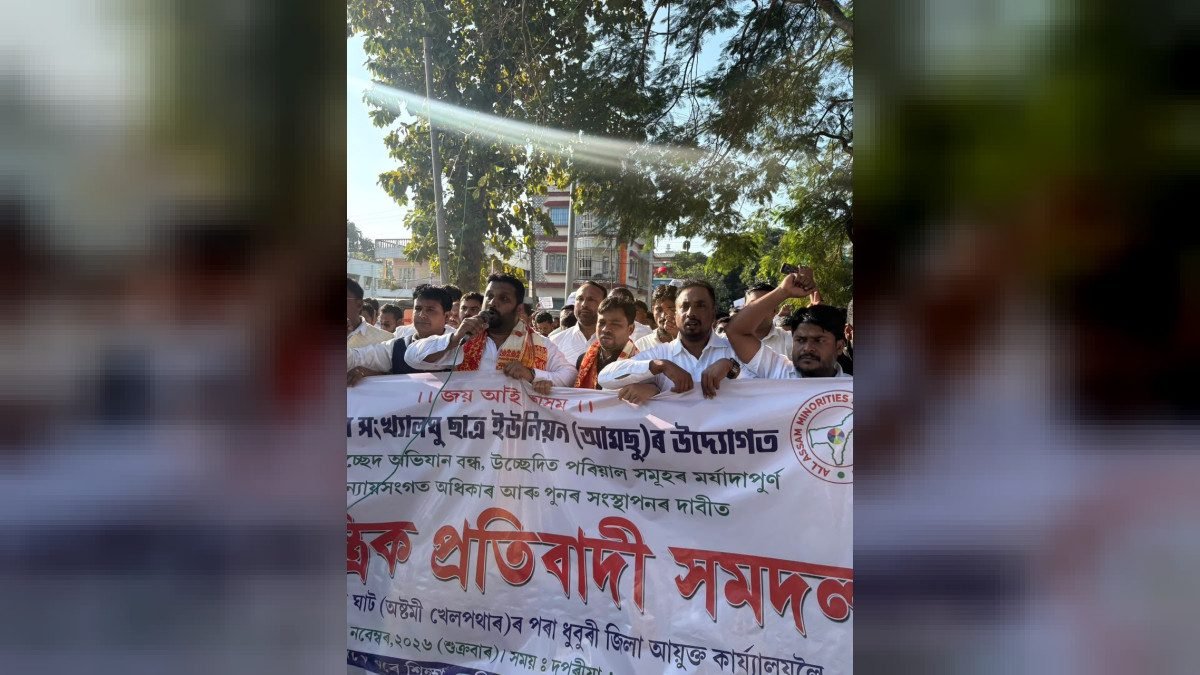
DHUBRI, Nov 27: The All Assam Minority Students' Union (AAMSU) on Friday held a protest march in Dhubri against eviction drives in different parts of the district and demanded rehabilitation for displaced families.
The organisation claimed that thousands of its workers and supporters took part in the protest and gheraoed the deputy commissioner's office. It demanded that the eviction drives be stopped and families rendered homeless be rehabilitated.
An AAMSU delegation later submitted a memorandum addressed to Chief Minister Himanta Biswa Sarma through the Dhubri deputy commissioner. In the memorandum dated November 27, 2026, the organisation claimed that eviction drives had left thousands of families homeless and that displaced people lacked adequate shelter, drinking water, sanitation and healthcare.
AAMSU said about 1,355 families were evicted from around 3,500 bighas of government khas land, 1,700 bighas of patta land and 200 bighas of allotted land in the Chikarkuta-Charuabakhra area. It claimed that four schools, four mosques, three madrasas, three graveyards, two Eidgahs and two anganwadi centres were among the institutions affected. Many displaced families were still living in temporary camps, it said, adding that a woman named Sakina Khatun died while staying in a camp.
In the Rangamati area of Alamganj, around 650 families were evicted from about 1,500 bighas of government khas land, the memorandum said. AAMSU sought protection of structures linked to a historic dargah, graveyard and Eidgah in the area.
The organisation also expressed concern over a proposed eviction drive in the Chapar-Phalimari area, which it said could affect around 2,000 families living on about 2,800 to 3,000 bighas of land. It claimed that around 700 of these families held patta land and that eviction notices had already been issued to more than 150 families in six villages.
AAMSU demanded that the proposed drive be suspended, displaced families be rehabilitated within a fixed timeframe, eligible landless families be given patta, and affected families receive compensation. It also sought food, drinking water, temporary shelter, medical care and other essential relief, besides an administrative committee to assess the condition of affected people and monitor rehabilitation.