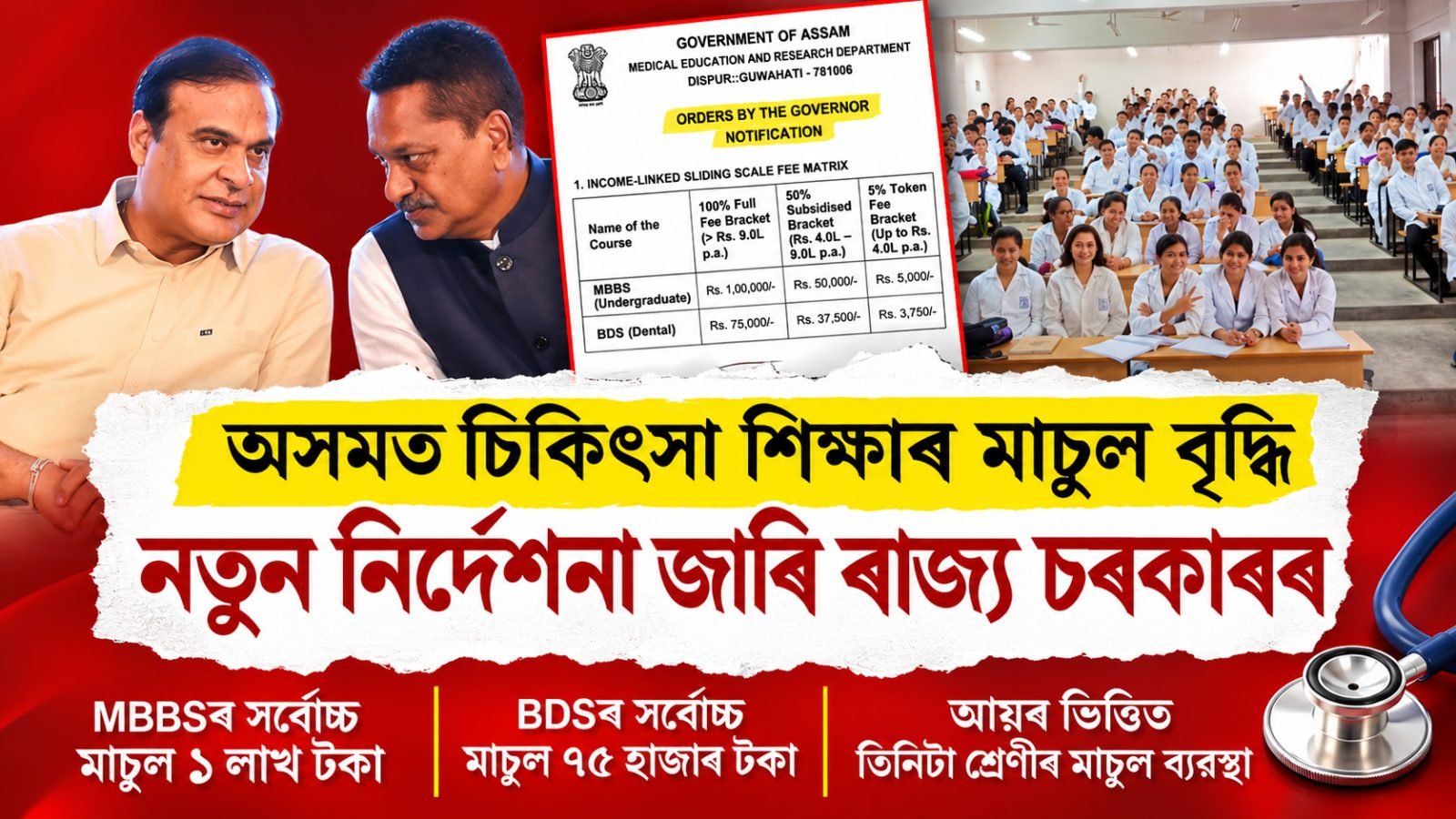
Guwahati, November 21: The decision to increase MBBS course fees in government medical colleges even after the admission process has been completed has triggered a fresh controversy surrounding the state's medical education system. The Medical Education and Research Department of Assam has fixed MBBS fees at up to ₹1 lakh per year based on the annual income of a student's family. The revised fee structure is not limited to newly admitted students. Students already pursuing their courses in the academic years 2022–23, 2023–24, 2024–25 and 2025–26 have also been directed to pay fees according to the revised income-based categories. In a notice issued by Gauhati Medical College and Hospital (GMCH) on November 21, students have been asked to deposit the revised fees within 30 days. The decision to revise the fee structure after admissions and extend the new system to existing students has triggered concerns among students and parents, while also raising questions about the rationale behind the government's policy.
According to an order issued by the Medical Education and Research Department on September 24, 2026, fees for MBBS and BDS courses in government medical and dental colleges across the state have been determined on the basis of annual family income. Under the revised fee structure, students whose family income exceeds ₹9 lakh annually will have to pay ₹1 lakh per year for MBBS and ₹75,000 for BDS. For students belonging to families with an annual income between ₹4 lakh and ₹9 lakh, the annual MBBS fee has been fixed at ₹50,000, while the BDS fee will be ₹37,500. Meanwhile, students whose family income is up to ₹4 lakh annually will have to pay ₹5,000 for MBBS and ₹3,750 for BDS.
This means that there is a significant difference in annual MBBS fees depending on the income category of a student's family. Students from families earning more than ₹9 lakh annually will have to pay ₹1 lakh per year, whereas those from families earning up to ₹4 lakh will pay ₹5,000. Although the government has introduced an income-based fee structure, there is scope to seek greater clarity regarding the basis for determining the income thresholds, the necessity of the fee revision and its impact on students.
Revised Fee Structure Extended to Students From the Previous Four Academic Years
The most significant aspect of this decision is that revised fee instructions have also been issued to students who have already secured admission and are currently pursuing their MBBS courses. According to a notice issued on November 21 by the Principal-cum-Chief Superintendent of GMCH, MBBS students from the academic years 2022–23, 2023–24, 2024–25 and 2025–26 have been asked to deposit the revised fees according to their respective family income categories. Students must submit the fees along with a new Income Certificate within 30 days of the issuance of the notice.
However, this does not mean that revised fees will be collected retrospectively for previous academic years. For students already pursuing their courses, the revised fee structure will be applicable only to the upcoming academic year. Nevertheless, applying a new fee structure to students who began their education based on the fee arrangements prevailing at the time of admission naturally raises questions.
In particular, students and parents make financial plans for several years of education after securing admission to an MBBS course. Any change in the fee structure while the course is underway may affect those financial plans. How affordable the revised fees will be for families who had decided to continue their children's education based on the previous fee structure and their financial capacity is also an important question.
Directive to Complete Fee Collection by November 30
Meanwhile, the Directorate of Medical Education (DME), in a directive issued to the principals of all government medical and dental colleges in the state on November 19, 2026, instructed them to complete the collection of fees from newly admitted students by November 30. The colleges have been directed to verify the annual family income category of each student and collect fees accordingly.
The directive also states that the entire amount collected must be deposited into the state treasury. Colleges will have to preserve documents relating to fee concessions. In addition, they must submit a final report containing details of fee collection and related information by December 2, 2026.
According to the directive, the fee amount will also be displayed on a monthly basis, although the annual fee will be collected in a single instalment at the beginning of the academic year. In other words, while the monthly equivalent of the fee will be indicated, students will have to deposit the entire annual amount at once. Whether financially disadvantaged families will be able to arrange such an amount in a single payment is also a matter that deserves consideration.
Provision for Fee Concessions of Up to 50 Per Cent
The new directive states that college principals may grant fee concessions of up to a maximum of 50 per cent under special circumstances. However, this concession is not automatic. Applications must be submitted with proper supporting documents in exceptional circumstances, and the principal must take a reasoned decision. This means that every student facing financial difficulties cannot be assured of receiving this benefit.
As proof of family income, students will have to submit a valid Income Certificate issued by a Circle Officer or District Commissioner, or a certificate under a social security scheme recognised as acceptable in the directive. Verifying the authenticity of the documents submitted to determine a student's income category will also be the responsibility of the college authorities.
However, despite the provision allowing concessions of up to 50 per cent, several questions remain: What circumstances will be considered exceptional? How will applications for fee concessions be processed? And what alternatives will be available to students if their applications are rejected? A clear policy and transparent procedure on these matters are essential.
Revised Fee Structure Not Applicable to All Medical Education Courses
The departmental directive specifies that this fee structure has been introduced only for MBBS and BDS courses in government medical and dental colleges. It does not apply to Nursing, Allied Health, postgraduate (PG), Super-speciality and other courses. Therefore, it would not be accurate to interpret the decision as a fee hike covering all medical education courses.
According to a Previous Fee Notice of a Medical College
According to an earlier fee notice available from a medical college, the government fee for the first-year MBBS course at Pragjyotishpur Medical College and Hospital for the 2025–26 academic session was listed as ₹2,400. However, this amount cannot be considered the entire annual fee. The same notice separately listed other charges in addition to the government fee, including one-time fees, student welfare, examination, library and hostel fees.
According to the said notice, the total amount, including all the listed fees, for students staying in the hostel was ₹32,700. Excluding hostel fees, the total amount was ₹26,700. Therefore, it would not be correct to treat ₹2,400 as the entire previous annual fee and directly compare it with the new fee of ₹1 lakh. To understand the actual difference between the old and new fee structures, the government needs to clearly publish the details of each fee component, its amount and the time of collection.
Government's Responsibility to Keep Medical Education Affordable
Securing admission to a government medical college is an opportunity earned by many students after years of preparation, hard work and intense competition. One of the key responsibilities of the public education system is to ensure that such opportunities are not restricted only to students from financially well-off families. Even while introducing an income-based fee structure, the government needs to consider the rationale behind the income thresholds, the cost of living, the number of family members and the actual financial circumstances of students.
Several direct questions have now been raised before the government: Why was there a need to change the fee structure after admissions had already been completed? Were students and parents consulted before taking this decision? What is the basis for fixing the annual family income threshold at ₹9 lakh? Will the government introduce any special assistance scheme to ensure that students facing financial difficulties can continue their education despite the revised fees? How will transparency and equality be ensured in the exercise of the principals' authority to grant fee concessions of up to 50 per cent?
Medical education is not merely a matter of building an individual career; it is also closely connected with the future doctors of the state and its healthcare system. Therefore, while determining fees, the government must give equal importance to students' rights, social justice and the affordability of education, alongside revenue generation. Whether the government will publicly explain the rationale behind the revised fee structure and its implications, while ensuring a more reliable protection mechanism for financially weaker students, remains the central question.