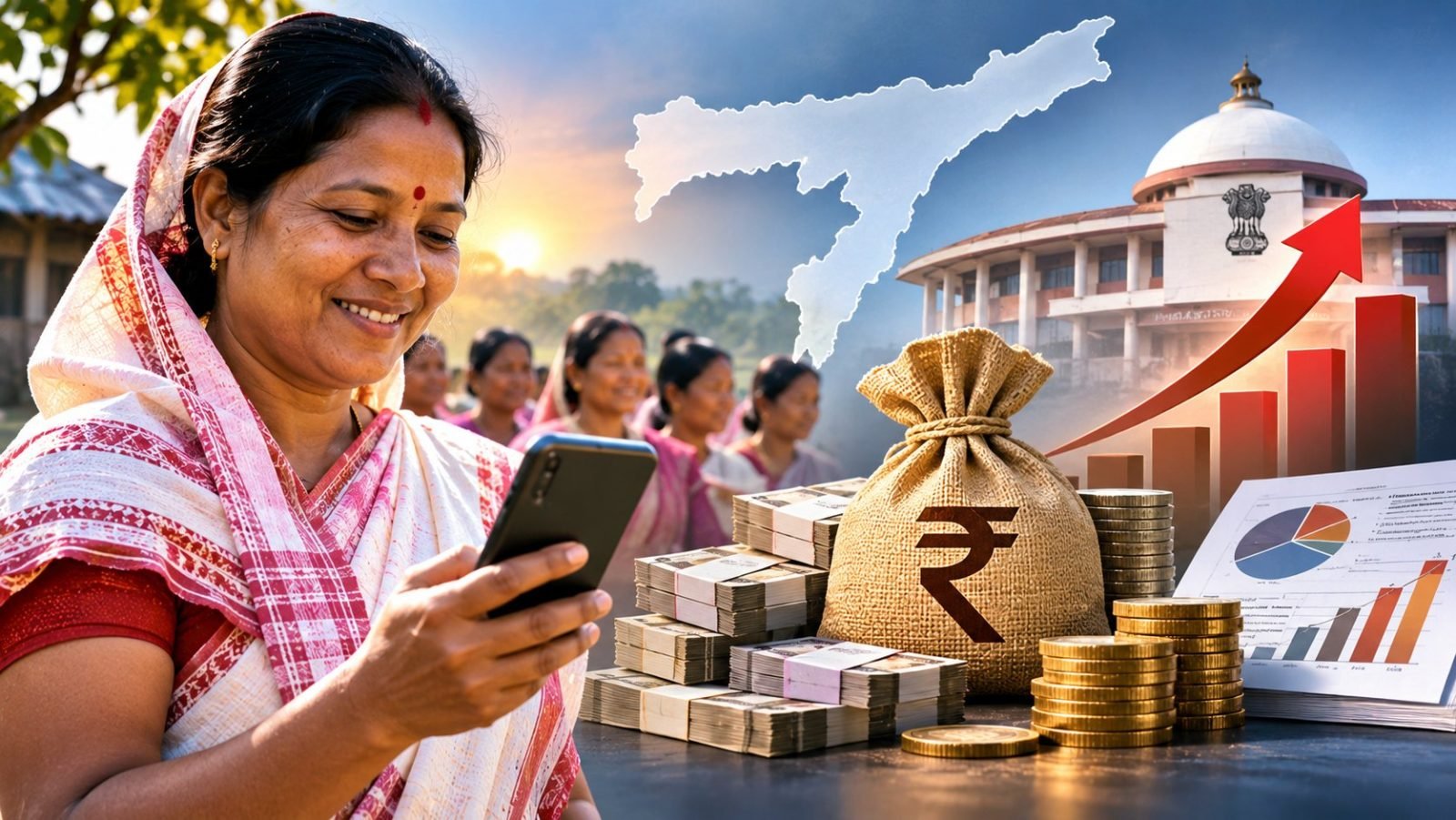
On 10 March 2026, the Government of Assam transferred ₹3,600 crore in a single day. Around 40 lakh women received ₹9,000 each under the Orunodoi scheme. The payment comprised four monthly instalments of ₹1,250 each, totalling ₹5,000, and a one-time Bihu bonus of ₹4,000.
It was the largest single-day direct benefit transfer under a state government welfare scheme in Assam's history. The transfer took place just five days before the Election Commission announced the Assembly election schedule.
The distinction in the payment matters. The ₹9,000 was not four months of assistance at ₹1,250 per month. Four instalments amounted to ₹5,000. The remaining ₹4,000 was a festival bonus. With around 40 lakh beneficiaries receiving ₹9,000 each, the total transfer came to ₹3,600 crore.
The Chief Minister described the transfer as a major welfare initiative and said the scheme was not linked to the coming Assembly elections. The government released the four months' assistance together with the Bihu bonus.
This episode does not ask whether Orunodoi helps the families who receive it. For many of them, it plainly does. It asks a narrower question: what does the scheme cost, and how much of that cost is effectively supported by borrowing?
How Orunodoi grew
| Stage | Monthly assistance | Beneficiaries / coverage |
|---|---|---|
| Launch, October 2020 | ₹830 | About 17 lakh families |
| 2021 | ₹1,000 | Coverage expanded |
| 2022 (Orunodoi 2.0) | ₹1,250 | About 24–24.6 lakh beneficiaries |
| September 2024 (Orunodoi 3.0) | ₹1,250 | 37.2 lakh beneficiaries at launch |
| October 2025 | ₹1,250 | PRS reported around 31 lakh beneficiaries and ₹3,500 crore disbursed up to October 2025 |
| March 2026 | ₹1,250 monthly instalment | Around 40 lakh women received the consolidated payment |
| October 2026 (special Puja payment) | ₹1,500 for October | Around 40 lakh beneficiaries |
Orunodoi was launched in October 2020 with a monthly assistance of ₹830 for around 17 lakh families. The payment increased to ₹1,000 in 2021 and to ₹1,250 in 2022.
Orunodoi 3.0 was launched in September 2024 with 37.2 lakh beneficiaries, up from approximately 24.6 lakh under the previous edition. The scheme was designed to expand coverage while updating beneficiary information and eligibility verification.
PRS records that around 31 lakh beneficiaries had received ₹3,500 crore up to October 2025. In March 2026, the government transferred ₹9,000 each to around 40 lakh women. These figures refer to different reporting dates and administrative stages; they should not be treated as a perfectly comparable year-on-year beneficiary series without further clarification from the government.
In September 2026, the Assam Cabinet approved a special increase in the Orunodoi payment from ₹1,250 to ₹1,500 for October as a Durga Puja gift. This was a one-month enhancement, not confirmation of a permanent increase in the monthly rate.
In five years, the scheme has expanded substantially in both its monthly assistance and its intended coverage. The scale of that expansion makes the question of its long-term financing increasingly important.
What does it cost?
| Financial year | Amount | Status |
|---|---|---|
| 2020–21 | ₹850 crore | Actual disbursement reported by PRS |
| 2023–24 | ₹3,420 crore | Budgeted |
| 2024–25 | ₹3,680 crore | Actual expenditure |
| 2025–26 | ₹5,000 crore | Budget Estimate |
| 2025–26 | ₹6,000 crore | Revised Estimate |
| 2026–27 | ₹3,700 crore | Budget Estimate |
The figures need to be read carefully. A Budget Estimate is the amount originally planned. A Revised Estimate is the government's updated projection during the financial year. Actual expenditure is what was ultimately spent, as recorded in the accounts.
For 2024–25, the actual expenditure on Orunodoi was ₹3,680 crore, against a budget provision of ₹3,750 crore. This figure is confirmed by the CAG's State Finances Audit Report for Assam.
For 2025–26, the original budget provision was ₹5,000 crore. The Revised Estimate increased this to ₹6,000 crore. PRS also reported that ₹3,500 crore had been disbursed to around 31 lakh beneficiaries up to October 2025.
For 2026–27, the government has allocated ₹3,700 crore to the scheme.
The three figures used in our original comparison—₹3,420 crore for 2023–24, ₹6,000 crore for 2025–26 and ₹3,700 crore for 2026–27—add up to ₹13,120 crore. Adding the subsequently confirmed 2024–25 actual expenditure of ₹3,680 crore takes the combined total of these four reported figures to ₹16,800 crore.
However, ₹16,800 crore is not a verified cumulative actual expenditure figure. It combines a Budget Estimate, an actual expenditure figure, a Revised Estimate and another Budget Estimate. The figures for 2021–22 and 2022–23 also need to be established from the relevant year-wise accounts before a complete historical total can be presented.
NewzNow has sought the missing year-wise figures from the government.
One more figure deserves attention. In the election year 2025–26, the Revised Estimate for Orunodoi was ₹1,000 crore higher than the original budget provision. The revised figure included the effect of advance payments and a festive bonus, according to PRS. The final actual expenditure for 2025–26 will be needed to establish how much was ultimately spent.
How much of it is borrowed?
No rupee in the state budget is individually labelled "borrowed" or "earned". Tax revenue, central transfers and loans flow into the government's overall pool of funds. Once that money enters the Consolidated Fund, it is not possible to identify a particular loan as the source of a particular beneficiary's Orunodoi payment.
But we can examine the state's fiscal deficit in relation to its expenditure to understand the scale of the borrowing gap.
For 2026–27, Assam plans net expenditure of ₹1,48,029 crore. Its fiscal deficit is projected at ₹26,186 crore, equivalent to 3 per cent of the state's Gross State Domestic Product.
The fiscal deficit is the gap between expenditure and receipts, excluding borrowings. It is financed through borrowing and other financing adjustments and adds to the government's liabilities.
Dividing the projected fiscal deficit by net expenditure gives us approximately 17.69 per cent. In other words, the fiscal deficit is equivalent to about 18 paise for every rupee of planned net expenditure.
For comparison, in 2024–25, Assam's actual fiscal deficit was ₹28,529.52 crore against net expenditure of ₹1,26,316.73 crore. That works out to approximately 22.6 paise for every rupee spent.
The position was more strained in the 2025–26 Revised Estimates. The fiscal deficit was projected at ₹49,710 crore against net expenditure of ₹1,69,939 crore. That is approximately 29.25 paise for every rupee of net expenditure.
These ratios do not mean that the same proportion of every individual scheme is directly financed by a specific loan. They provide an illustration of the state's overall fiscal gap.
Applying the borrowing ratio to Orunodoi
If we apply the 2026–27 fiscal-deficit-to-net-expenditure ratio of 17.69 per cent to Orunodoi's ₹3,700 crore allocation, the result is approximately:
- ₹655 crore as the scheme's fiscal-deficit-equivalent component.
- At the CAG-reported average effective interest rate of 6.76 per cent on Assam's government debt in 2024–25, this would imply approximately ₹44 crore in annualised interest, assuming a full year's interest on that illustrative amount.
The same calculation can be applied to the 2025–26 Revised Estimate. The fiscal-deficit-to-net-expenditure ratio for that year was approximately 29.25 per cent.
- Of the ₹6,000 crore Revised Estimate, approximately ₹1,755 crore would be the fiscal-deficit-equivalent component.
- At 6.76 per cent, that amount would carry an illustrative annualised interest cost of approximately ₹119 crore.
These are analytical illustrations, not accounting entries. They do not establish that the government borrowed these exact amounts specifically to pay Orunodoi beneficiaries. Nor are the interest figures actual scheme-level interest bills.
The same calculation could be applied to roads, salaries, infrastructure projects or any other government expenditure. Its purpose is to show how the state's overall borrowing gap and interest costs relate to the scale of its spending commitments.
The central point remains: when government expenditure is supported by borrowing, the financial consequences do not end when the money is paid out. The state continues to carry the cost of servicing its debt.
Orunodoi and Assam's interest bill
In Episode 1 of this series, we examined Assam's rising interest obligations.
PRS estimates that the state will spend ₹12,347 crore on interest payments in 2026–27. The corresponding figure was ₹11,012 crore in the 2025–26 Revised Estimates and ₹9,468 crore in 2024–25 actuals.
The projected 2026–27 interest bill is approximately 3.3 times the entire ₹3,700-crore Orunodoi allocation.
Interest payments are projected to rise by around 12 per cent over the 2025–26 Revised Estimate. Compared with the 2024–25 actual figure, the 2026–27 projection represents an annualised increase of approximately 14 per cent over two years.
Interest payments are a committed expenditure. They must be met before the government can decide how much additional room it has for other priorities.
If interest obligations continue to grow faster than the state's revenue, the government's flexibility to finance welfare programmes, infrastructure and other public services could come under pressure.
Families who depend on Orunodoi therefore have a direct stake in how much Assam borrows, how efficiently it uses public money and how it manages its long-term debt.
But what does Assam's debt position actually look like?
A balanced examination must also consider the state's overall debt position rather than looking only at the interest bill.
According to the CAG's State Finances Audit Report for 2024–25, Assam's outstanding liabilities stood at approximately 26.84 per cent of GSDP, below the prescribed ceiling of 32 per cent.
However, the same report recorded a fiscal deficit of 4.43 per cent of GSDP in 2024–25, exceeding the 3.5 per cent fiscal-deficit target applicable to the state that year.
These two figures tell different parts of the story. Assam's outstanding liabilities remained below the prescribed debt-to-GSDP ceiling, but its fiscal deficit exceeded the applicable target. Both facts matter when assessing the state's ability to sustain its expenditure commitments.
The government's side
1. It reaches women directly
Money goes straight into the bank accounts of women beneficiaries, without middlemen. The Chief Minister has described Orunodoi as the largest welfare scheme in Assam's history. Direct Benefit Transfer also makes the payment process more transparent and traceable.
2. It targets vulnerable households
Orunodoi 3.0 includes eligibility provisions for vulnerable groups such as destitute women, widows, persons with disabilities and transgender persons. The government has also emphasised updating beneficiary records and using Aadhaar-linked payment systems to reduce duplication.
3. The March payment was presented as a welfare disbursement
The government described the March 10 transfer as a major welfare initiative. The Chief Minister said the scheme was not linked to the coming Assembly elections. The payment combined four months' instalments with a one-time Bihu bonus.
The transfer took place on March 10. The Election Commission announced the Assembly election schedule on March 15, when the Model Code of Conduct came into effect. The available published material establishes this timeline, but does not establish that the government made the payment specifically because the Model Code of Conduct would otherwise have interrupted monthly instalments.
4. Welfare is also an investment
Supporters argue that cash in the hands of poorer households is spent on food, medicines, nutrition and education. Such spending can support household consumption and the local economy. The scheme's social impact cannot be measured only by the amount transferred or the interest paid on government borrowing.
These are serious arguments. Welfare assistance can provide economic security to households that need it. But the scale of public spending, the timing of large transfers and the long-term cost of financing them are also legitimate questions of public interest.
The purpose of this analysis is not to argue that Orunodoi should exist or should not exist. It is to ask whether the government can transparently demonstrate its actual cost, explain changes in expenditure and show how the scheme will be financed sustainably.
Five questions for the government
- What was the actual expenditure on Orunodoi in each financial year from 2020–21 to 2025–26? The public deserves a complete year-wise account, including the years for which the figures have not yet been established.
- Why did the 2025–26 Revised Estimate rise by ₹1,000 crore over the original budget provision? What portion of the increase was due to advance payments and the festive bonus, and what was the final actual expenditure? Was the additional expenditure approved through the appropriate legislative process?
- How many beneficiaries were removed during the Orunodoi 3.0 verification process, and why? How many new beneficiaries were added, and what safeguards were used to ensure that eligible families were not excluded?
- Did the ₹3,600-crore transfer on 10 March 2026 require additional borrowing or any special cash-management arrangement during that month? What was the source and timing of the funds used for the transfer?
- How will the government finance the scheme if monthly assistance is increased or coverage is expanded while interest payments and other committed expenditure continue to rise?
Conclusion: welfare today, fiscal responsibility tomorrow
Orunodoi has become one of Assam's most visible welfare commitments. Its expansion has brought direct financial assistance to a large number of women and households. For many beneficiaries, the money is not an abstract budgetary figure; it helps meet everyday expenses.
But a welfare scheme of this scale must also be examined through the lens of public finance. The distinction between budgeted allocations, revised estimates and actual expenditure matters. So does the difference between a scheme's cost and the state's overall borrowing requirement.
Borrowing is not automatically bad. Governments borrow to build infrastructure, support development and meet public needs. The real questions are how much is borrowed, what it finances, what return or public benefit it generates, and whether the resulting debt can be serviced without squeezing future priorities.
For Orunodoi, the question is not simply how much money reaches beneficiaries today. It is also whether Assam can continue to deliver that support tomorrow without placing an unsustainable burden on its finances.
Sources:
- PRS Legislative Research – Assam Budget Analysis 2026–27
- CAG – State Finances Audit Report, Government of Assam, 2024–25
- Government of Assam – Orunodoi Scheme
- PTI – Orunodoi 3.0 launch and beneficiary coverage, 19 September 2024
- The Economic Times – ₹9,000 transfer to 40 lakh beneficiaries, 10 March 2026
- The New Indian Express – ₹4,000 Bihu bonus and March 2026 transfer
- NDTV – Special ₹1,500 Orunodoi payment for October 2026
- Press Information Bureau / Election Commission – Model Code of Conduct, 16 March 2026
Methodology: Fiscal-deficit-equivalent share = Fiscal Deficit ÷ Net Expenditure. Illustrative interest = Fiscal-deficit-equivalent amount × 6.76 per cent. The 6.76 per cent rate is the CAG-reported average effective interest rate on Assam's government debt in 2024–25. These calculations are analytical illustrations and do not identify actual scheme-level borrowing or interest payments.
NewzNow has invited the Government of Assam to respond to the questions raised in this report. Any response received will be published unedited.