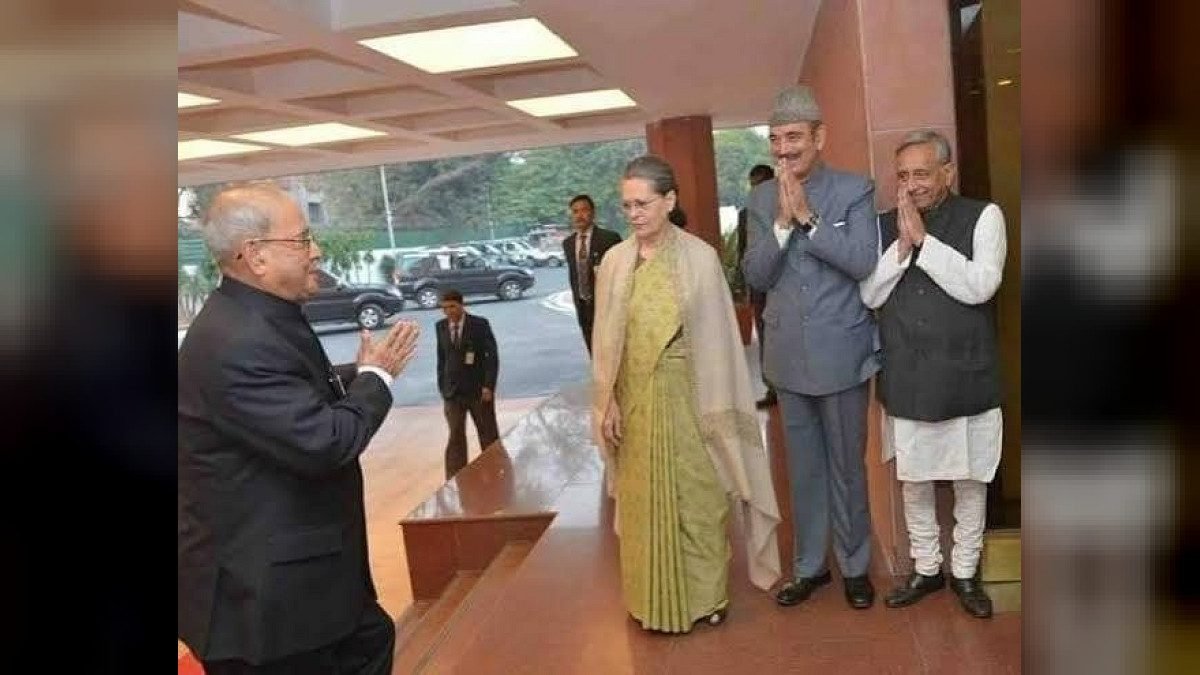
Sonia Gandhi wrote in her memoir that Pranab Mukherjee suggested in 2010 that it might be time for a “change at the top”, a remark she understood as signalling his long-held wish to become prime minister. She said she changed the subject and maintained that Prime Minister Manmohan Singh, not she, ran the United Progressive Alliance government.
The disclosures were made in Gandhi’s 526-page memoir, Belonging: A Journey of Love, which was released on Tuesday.
At a glance
- The memoir begins with an inscription from the Rig Veda calling on people to move, speak and think together in concord.
- Gandhi said the Prime Minister’s Office had categorically denied that official files were ever shown to her.
- The Congress nominated Mukherjee as the UPA’s presidential candidate in 2012, and he was elected President.
- Mukherjee served as President from 2012 to 2017 and died in 2020.
What happened
Gandhi wrote that a core group met Singh every week to coordinate between the Congress and the government. Its members included Mukherjee, Arjun Singh, A K Antony and Ahmed Patel.
The group also met regularly as a strategy forum to discuss issues to be raised in Parliament. Gandhi said Mukherjee would occasionally stay back after those meetings for a private conversation.
She wrote that Mukherjee had developed serious differences with then finance minister P Chidambaram. During one such discussion in 2010, after expressing his frustration, Mukherjee suggested that there might be a need for a change at the top.
Gandhi said she understood the remark as an indication of Mukherjee’s long-held desire to become prime minister. She said she gently moved the conversation to another subject.
“Though he may have been disappointed, he never made me feel he held it against me,” Gandhi wrote.
She said she continued to meet Mukherjee after he became President, mainly to speak with a politician whom she described as erudite and knowledgeable.
Who said what
Gandhi rejected the allegation that she acted as a “back-seat driver” during the UPA years. She wrote that Singh was the prime minister and that, as Congress president, she could offer views, suggestions and express differences, but it was her duty to defer to him.
She said she was determined not to create any misunderstanding that could weaken the government or give its opponents an opportunity to benefit.
Gandhi described the arrangement between Singh and herself as an “unspoken division of responsibility” that worked smoothly. Singh led the government, while she led the Congress party, she said.
She denied allegations that she had sought files from the Prime Minister’s Office, interfered in administrative matters or influenced key appointments. Gandhi wrote that the allegation which distressed her most was that she had examined official files despite being outside the government.
She said she had been particular about following rules during that period. Gandhi also referred to comments by Singh’s daughter, Upinder Singh, who described allegations in a book by one of his former aides as a betrayal of trust.
Upinder Singh said her father’s relationship with Gandhi rested on mutual trust and respect, Gandhi wrote.
Background
Singh served as prime minister from 2004 to 2014, when the UPA was in power. Gandhi wrote that accounts portraying her as the real authority behind the government persisted during those years and afterwards.
Her memoir revisits the functioning of the Congress-led government and her working relationship with Singh. It also records her account of how coordination was maintained between the party leadership and the government.