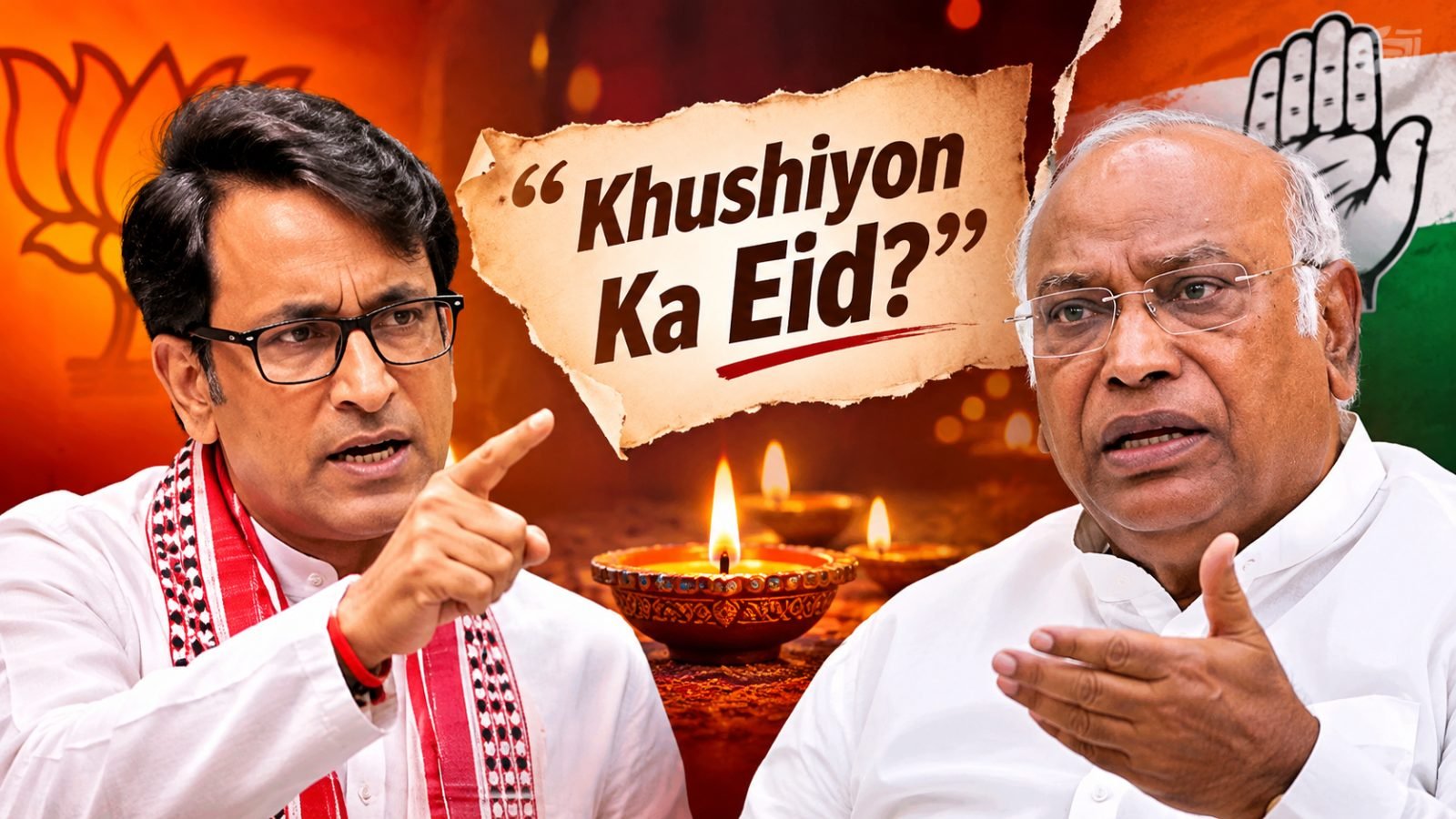
The Bharatiya Janata Party targeted Congress president Mallikarjun Kharge after he described Diwali as “Khushiyon Ka Eid” while speaking to reporters during the festival. The BJP accused the Congress of appeasement and vote-bank politics and called the party “anti-Sanatan”.
The controversy also revived the political dispute over former Congress president Sonia Gandhi’s comments on the demolition of the Babri Masjid in 1992. BJP leaders linked Kharge’s Diwali greeting with Gandhi’s remarks to widen their attack on the Congress.
At a glance
- BJP spokesperson Pradeep Bhandari criticised Kharge in a social media post dated November 8.
- He alleged that the Congress pursued appeasement and vote-bank politics even during Diwali.
- The BJP said Hindu festivals should retain their distinct identity.
- The Congress said “Eid” was used in its broader sense of joy and celebration.
- BJP leaders linked the row with Sonia Gandhi’s remarks on the Babri Masjid demolition.
What happened
Kharge used the phrase “Khushiyon Ka Eid” in his Diwali greeting to reporters. The BJP objected to the wording, saying Diwali should not be described in a way that altered the identity of a Hindu festival.
Bhandari responded in a post on November 8. He said the Congress president had called Diwali “Khushiyon Ka Eid” and alleged that the party thought of appeasement and vote-bank politics even on the occasion of Diwali.
The BJP’s criticism was directed at the wider Congress leadership as well. It referred to Kharge and senior Congress leader Rahul Gandhi while alleging that the party had taken a position against Sanatan traditions.
The Congress rejected the charge of appeasement. It said the word “Eid” had been used in its wider linguistic sense, referring to a happy or joyous occasion. The party said the expression was intended as a metaphorical appeal for national unity across cultures and did not seek to change Diwali’s identity.
Who said what
Bhandari said Kharge’s Diwali message reflected what he described as the Congress’s appeasement politics. He linked it to Gandhi’s remarks on the Babri Masjid demolition, saying she had expressed grief over Babri while Kharge had sought to appease people through his greeting.
“Congress President calls Diwali ‘Khushiyon Ka Eid’! Even on Diwali, Congress thinks of appeasement & vote bank!” Bhandari said in his post. He described the Congress as “anti-Sanatan”.
The BJP also maintained that Hindu festivals had their own distinct identity and should not be described differently. The party used the controversy to question the Congress’s position on Hindu traditions.
The Congress said the phrase referred to happiness and celebration. It said the greeting should be understood as a message of unity among people from different communities and cultures, rather than as a religious or political statement.
Rajya Sabha MP and BJP spokesperson Sudhanshu Trivedi, commenting separately on Gandhi’s remarks, alleged that the Congress had sympathy for Mughal ruler Babur. He said Babur had been in the Congress’s heart then and remained so.
Background
The latest exchange followed Gandhi’s comments in an interview before the release of her memoir,
Belonging: A Journey of Love. She recalled the demolition of the Babri Masjid on December 6, 1992, and said she had cried after watching the incident unfold on television.
Gandhi said the demolition made her realise that India faced a long struggle to preserve its secular foundations. She also said the Congress had been complacent in several ways, which had partly contributed to the rise of the BJP and its Hindutva politics.
Her comments triggered a political confrontation. BJP leaders accused the Congress of being sympathetic towards Babur and questioned Gandhi’s recollection of watching the demolition on television.
Why it matters for Assam and the Northeast
The row formed part of a wider national political contest over religious symbolism, secularism and the Congress’s record. The BJP used Kharge’s greeting and Gandhi’s comments to press its charge that the Congress practised appeasement politics.
For the Congress, the issue centred on the meaning of the word “Eid” and whether the greeting was intended as a message of celebration and unity. The dispute highlighted the sharply different political readings of the same expression.
What next
The immediate political focus remained on the BJP’s allegation that the Congress had sought to dilute the identity of a Hindu festival. The Congress maintained that Kharge’s words conveyed joy and unity, and did not alter the character of Diwali.
The controversy also kept Gandhi’s account of the 1992 demolition in the political debate, with BJP leaders continuing to link her remarks with their criticism of the Congress.