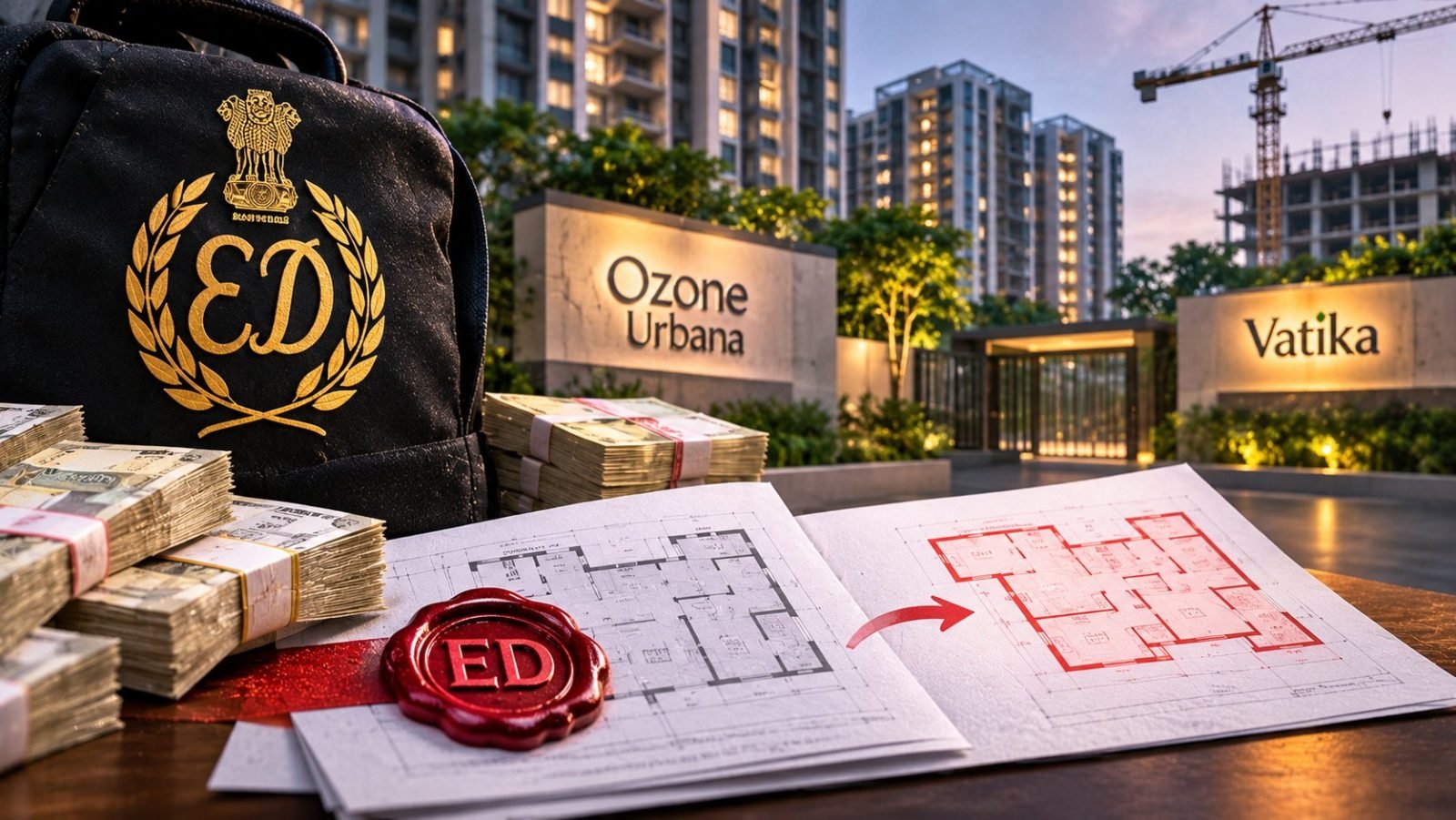
For tens of thousands of middle-class Indian families, buying an apartment or residential plot means committing life savings and 20-year home loans—only to watch promised towers stall into concrete shells or allotted plots disappear from revised master plans.
Over a dramatic 48-hour window on November 25 and 26, 2026, the Directorate of Enforcement (ED) struck two of India's biggest real-estate markets—Bengaluru and Gurugram—provisionally attaching properties worth a combined ₹1,248.66 crore under the Prevention of Money Laundering Act (PMLA), 2002.
Inside the Twin ED Enforcement Strikes
According to official press releases issued by the Directorate of Enforcement:
- Bengaluru — ₹702.70 Crore Attached (Ozone Urbana): In an official November 26 release, ED Bengaluru confirmed the provisional attachment of immovable properties worth ₹702.70 crore against M/s Ozone Urbana Infra Developers Pvt. Ltd. and others over allegations of criminal conspiracy, cheating, failure to deliver booked apartments, and withholding refunds from buyers.
- Gurugram — ₹545.96 Crore Attached (Vatika Group): In a parallel ED Gurugram release covering its November 25 action, investigators provisionally attached properties worth roughly ₹545.96 crore linked to M/s Vatika Limited (Vatika Group) and its promoters Anil Bhalla, Gautam Bhalla, and others over allegations of fraudulent inducement, non-delivery of residential plots, double selling of plots, and related offences.
The Layout Trick: How Allotted Plots Vanish on Paper
Beyond the attachment totals, a November 27 forensic breakdown by Vantage InSights (citing Hindustan Times and The Times of India reporting on the Vatika order) exposes a subtle mechanism quietly trapping plot buyers across India's fast-growing suburban corridors: post-allotment layout revisions.
As detailed in the ED's allegations summarized in the report, money was collected from buyers before formal plot-wise agreements were signed. Subsequent revisions to the master layout caused original plots to be renumbered or physically shifted—leaving families holding old allotment letters referencing plot numbers that no longer appear on the latest government-approved plan.
Homebuyer Audit: 3 Checks Affected Families Should Run Immediately
Because PMLA attachment proceedings run on a separate legal track from individual buyer refunds or possession claims, real-estate and legal analysts stress that buyers in delayed or revised projects must lock down their documentary proof right away:
- Freeze Your Baseline Dossier: Gather your original allotment letter, signed builder-buyer agreement, promoter legal entity name, sector, project phase, plot or unit number, area, and exact boundary markings.
- Cross-Check State RERA Plans: Download the latest sanctioned layout plan and approval date from the relevant state RERA portal (such as Haryana RERA or Karnataka RERA) to confirm whether your parcel was simply renumbered or physically relocated.
- Demand Written Mapping & Match Bank Trails: Seek a dated, written plot-number reconciliation letter from the developer and match every payment receipt line-by-line against your bank statements before pursuing RERA orders, consumer forum remedies, or PMLA restitution claims.
Legal Status
Both attachment orders are currently provisional under the PMLA, 2002, and will be examined by the PMLA Adjudicating Authority, where the named developers and promoters retain the legal right to contest the allegations.
Source Credits & Verification: Official press releases from ED Bengaluru (Ozone Urbana Attachment, PDF), ED Gurugram (Vatika Group Attachment, PDF), and the Directorate of Enforcement Portal; forensic allotment guide via Vantage InSights (citing Hindustan Times and The Times of India).